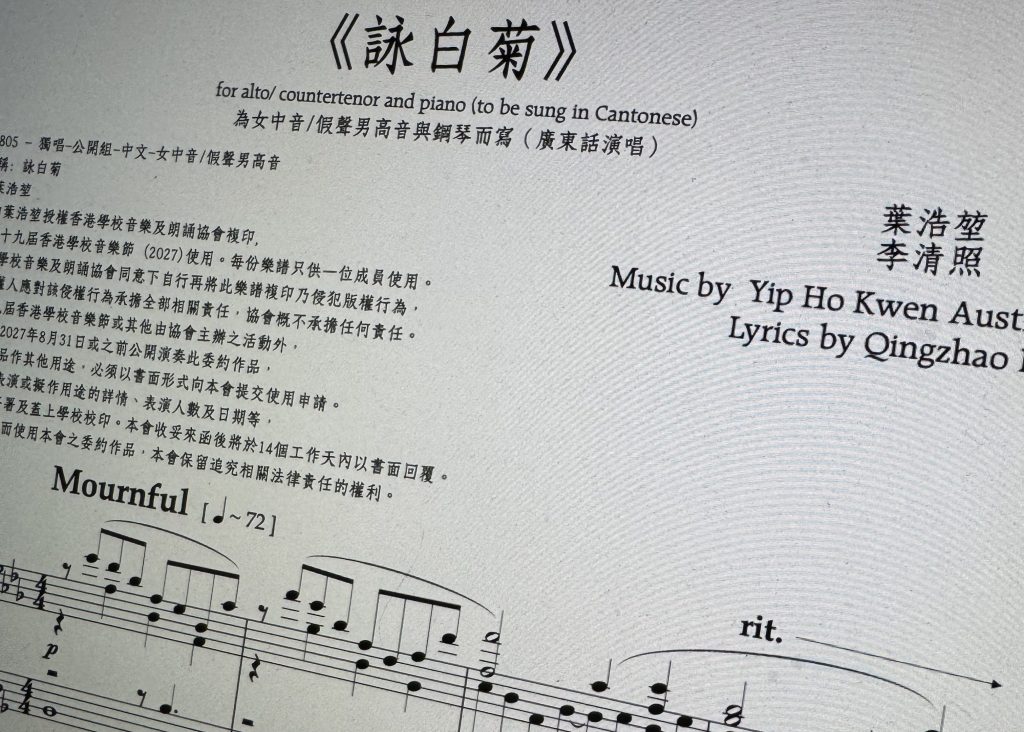
Commissioned by Hong Kong Schools Music and Speech Association香港學校音樂及朗誦協會委約作品
Ode to the White Chrysanthemum draws inspiration from Duo Li: Ode to the White Chrysanthemum, a Song dynasty lyric traditionally attributed to the poet Li Qingzhao. Through the image of a white chrysanthemum weathering the autumn wind and rain, the poem reflects on purity, solitude, and the inevitable passage of time.
Allusions to the ancient poets Qu Yuan and Tao Yuanming associate the flower with integrity and moral dignity. Its delicate beauty, gradually fading as autumn draws to a close, becomes a poignant metaphor for the fragility of life and the human desire to preserve what is cherished.
Written for solo alto voice, the work explores the intimate emotional landscape of the poetry, where admiration gives way to melancholy, and tenderness coexists with quiet resilience. The white chrysanthemum emerges not merely as a flower, but as a reflection of the human spirit—vulnerable to the passage of time, yet retaining its grace and dignity even in decline.
This song is written in Cantonese.
《詠白菊》取材自相傳為宋代女詞人李清照所作的〈多麗・詠白菊〉。詞中以白菊為題,描繪其在秋風冷雨中逐漸凋零,卻始終保有清雅脫俗的氣韻。詞人借屈原與陶淵明等歷史人物的意象,寄託對高潔品格的嚮往,並透過惜花之情,抒發對歲月流逝、生命無常的感慨。
白菊既象徵純潔與孤高,亦映照人面對無情世事時的脆弱與堅持。從「小樓寒」的淒清,到「雪清玉瘦」的憔悴,詞中細膩的情感在景物與心境之間流轉。
本作透過女低音獨唱,探索詩詞中含蓄而深沉的情感世界,讓白菊成為人類內心的寫照:縱然美好終將消逝,仍在無常之中保有尊嚴與自身的芬芳。
本曲以廣東話演唱。